Patanjali
| Part of a series on | ||||||||||||||||||||||||||
| Hindu philosophy | ||||||||||||||||||||||||||
|---|---|---|---|---|---|---|---|---|---|---|---|---|---|---|---|---|---|---|---|---|---|---|---|---|---|---|
 | ||||||||||||||||||||||||||
| stika | ||||||||||||||||||||||||||
| ||||||||||||||||||||||||||
Related Indian philosophies
| ||||||||||||||||||||||||||
| People | ||||||||||||||||||||||||||
Acharyas
| ||||||||||||||||||||||||||
Sant Mat (Bhakti movement)
| ||||||||||||||||||||||||||
Patañjali (Sanskrit: , IPA: [ptli]) is a Sanskrit proper name. Several important Sanskrit works are ascribed to one or more authors of this name, and a great deal of scholarship has been devoted over the last century or so to the issue of disambiguation.[1]
Amongst the more important authors called Patañjali are:[2][3][4]
- The author of the Mahbhya, an advanced treatise on Sanskrit grammar and linguistics framed as a commentary on Ktyyana's vrttikas (short comments) on Pini's Adhyy. This Patañjali's life is the only one which can be securely dated (as one of the grammatical examples he uses makes reference to the siege of the town of Sket by the Greeks, an event known from other sources to have taken place around 120 BC).
- The compiler of the Yoga Stras , an important collection of aphorisms on Yoga practice,[5] who according to some historians was a notable person of Samkhya,[6][7] contemporaneous with Ishvarakrishna's Samkhya-karika around 400 CE.[7] He was native to Kashmir.
- Patanjali is one of the 18 siddhars in the Tamil siddha (Shaiva) tradition.
- The author of an unspecified work of medicine (yurveda).[8]
In some Sanskrit grammatical works, Patañjali is called "the man from Gonarda". Gonarda is the ancient name of Gonda - a district of Uttar Pradesh, about 50 km north of Ayodhya. Greek chronicles mention about Paatanjali, when they laid their siege on Saket i.e. Ayodhya in 2nd century BC. This implies that Paatanjali most probably was from Gonda, a district of immense importance where Buddha and Mahaavira resided. In fact Shravasti, just off Gonda, further to north, was a center of power during that millennium and was the capital of the said Janapad. Beside, this was an area of traditional Sanskrit learning. Some hold the view that he was born at the "Gonarda" situated at Thiru Kona Malai, Sri Lanka. This tradition is corroborated in Tirumular's seventh-century Tamil Tirumandhiram, which describes him as hailing from Then Kailasam (Koneswaram temple, Trincomalee), and tradition has him visiting the Thillai Nataraja Temple, Chidambaram, where he wrote the Charana Shrungarahita Stotram on Nataraja.
Name
The compound name Patañjali has been explained by Sanskrit commentators in two ways. The first explanation of the word is añjalau patan iti patañjali (Patañjali is one falling into folded hands), which is a mayravyasakdi compound with akandhvdi Sandhi.[9] The name comes from a legend about his birth which says that ea, the divine serpent-king, incarnated as a snakelet and fell into the folded hands (Anjali Mudra) of a Brahmin.[9] The second explanation parses the word as a Bahuvrihi compound patanto namaskryatvena jannmañjalayo yasmin viaye sa (He for whom the folded hands of people are falling is Patañjali).[9] The compound name Patan jali: "Patan" is 'bank' and "Jal" is 'water', in the Sindhi language of the Indus Valley Civilization.[10]
Life
That the Patañjalis who wrote on Yoga and on grammar were two different scholars was compellingly argued by the great scholar of Sanskrit literature, Louis Renou.[11] Many outstanding scholars since then have re-examined the question and come to the same conclusion.[12]
The tradition that one Patañjali wrote treatises on grammar, medicine and yoga is memorialised in a verse by Bhoja at the start of his commentary on the Yogasutras. This tradition is discussed by Meulenbeld[8] who traces this "relatively late" idea back to Bhoja (11th century), who was perhaps influenced by a verse by Bharthari (ca. 5th century) that speaks of an expert in yoga, medicine and grammar who, however, is not named.
Grammar tradition
In the grammatical tradition, Patañjali is believed for the reason given above to have lived in the second century BCE[9] Some say that he lectured on Paninian grammar at a place called Ngakpa, which is identified with modern day Nagakuan (Hindi: ).[9] He lectured for 85 days, which resulted in the 85 hnikas or "daily lessons" of the Mahbhya.[9] Many writers in the grammar tradition, including Bhaoj Dkita, Hari Dkita, Ngea Bhaa, and Kaunda Bhaa, held Patañjali to be an incarnation of the mythical serpent ea.[9]
Yoga tradition
In the Yoga tradition, Patañjali is a revered name and has been deified by many groups, especially in the Shaivite bhakti tradition. It is claimed by some that Patañjali is an incarnation of the mythical serpent Ananta. This Patañjali's oeuvre comprises the sutras about Yoga (Yogastra) and the commentary integral to the sutras, called the Bhya. In the past, the sutras and the Bhaya have been considered by some to have had different authors, the commentary being ascribed to "an editor" (Skt. "vysa"). However, a recent comprehensive re-examination of all the evidence has confirmed the view of many older Sanskrit authors in the period before 1000 that one and the same person composed the sutras and the Bhya commentary.[13] The same study also confirms the date of composition of this work as falling in approximately 400 BC.[14]
Tamil Shaivite legend
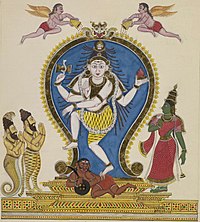
Regarding his early years, a Tamil Shaiva Siddhanta tradition from around 10th century AD holds that Patañjali learned Yoga along with seven other disciples from the great Yogic Guru Nandhi Deva, as stated in Tirumular's Tirumandiram (Tantra 1).
Nandhi arulPetra Nadharai Naadinom
Nandhigal Nalvar Siva Yoga MaaMuni
Mandru thozhuda Patañjali Vyakramar
Endrivar Ennodu (Thirumoolar) Enmarumaame
Translation[15]
We sought the feet of the Lord who graced Nandikesvara
The Four Nandhis,
Sivayoga Muni, Patañjali, Vyaghrapada and I (Thirumoolar)
We were these eight.
The ancient Kali Kautuvam also describes how Patañjali and Vyagrapada gathered along with the gods in Thillai near Chidambaram to watch Shiva and Kali dance and perform the 108 mystic Karanas, which formed the foundation for the system of Natya Yoga. He has also written Charana Shrungarahita Stotram on Nataraja.
This Tamil tradition also gives his birthplace in South Kailash Koneswaram temple, Trincomalee. Some other traditions feel that his being born in Bharatavarsha the part of the ancient world corresponding to South Asia is beneath his godlike status, and that he must have been born in the Jambudvipa, the mythical center of the universe.
Patañjali as Siddha is also mentioned by the goldsmith-sage Bogar:
It was why my Grandfather who said, "Climb and see."
But it was Kalangi Nathar who gave me birth.
Patañjali,Viyagiramar,and Sivayogi Muni all so rightly said,
"Look! This is the path!" Bhogar 7000 (translation by Layne Little)
This tradition also holds that Patañjali was a master of dance.
Other legends
In one popular legend, Patañjali was born to Atri and his wife Anasuya (this would make him go back to the time of the creation by Brahma). According to this tradition, Anasuya had to go through a stern test of her chastity when the Trimurti themselves came as Bhikshuks and asked her for Bhiksha. She passed their test by accepting them as her children and fed them. She got the boon where all the three Murtis will be born to them. They were Soma Skandan or Patañjali, Dattatreya, and Durvasa.
Samadhi
The Samadhi of Patanjali Maharishi is believed to be in Tirupattur Brahmapureeswarar Temple (30 km from Trichy), where Lord Brahma installed 12 Shiva Lingams and worshipped Lord Shiva to get back his Tejas.[citation needed]
Shankaracharya's guru had told Shankaracharya that Patanjali was reincarnated as Govinda Bhagavatpada and was meditating in a cave somewhere in the state of samadhi.[16]
Ascribed works

Whether the two works, the Yoga Sutras and the Mahbhya, are by the same author has been the subject of considerable debate. The authorship of the two is first attributed to the same person in Bhojadeva's Rajamartanda, a relatively late (10th century) commentary on the Yoga Sutras,[17] as well as several subsequent texts. As for the texts themselves, the Yoga Sutra iii.44 cites a sutra as that from Patanjali by name, but this line itself is not from the Mahbhya. This 10th-century legend of single-authorship is doubtful. The literary styles and contents of the Yogastras and the Mahbhya are entirely different, and the only work on medicine attributed to Patañjali is lost. Sources of doubt include the lack of cross-references between the texts, and no mutual awareness of each other, unlike other cases of multiple works by (later) Sanskrit authors. Also, some elements in the Yoga Sutras may date from as late as the 4th century AD,[4] but such changes may be due to divergent authorship, or due to later additions which are not atypical in the oral tradition. Most scholars refer to both works as "by Patanjali", without meaning that they are by the same author.
In addition to the Mahbhya and Yoga Stras, the 11th-century commentary on Charaka by the Bengali scholar Cakrapidatta, and the 16th-century text Patanjalicarita ascribes to Patañjali a medical text called the Carakapratisaskta (now lost) which is apparently a revision (pratisaskta) of the medical treatise by Caraka. While there is a short treatise on yoga in the medical work called the Carakasahit (by Caraka), towards the end of the chapter called rrasthna, it is notable for not bearing much resemblance to the Yoga Stras, and in fact presents a form of eightfold yoga that is completely different from that laid out by Patañjali in the Yoga Stras and the commentary Yogastrabhya.
The tradition that holds that all three works are by the same author is summed up in this verse from the beginning of Bhoja's Rjamrttanda commentary on the Yoga Stras:[18]
yogena cittasya, padena vc, mala arrasya ca vaidyakena
yo'pkarot ta pravara munn patañjali prñjalir nato'smi
English translation: I bow with my hands together to the eminent sage Patañjali, who removed the impurities of the mind through yoga, of speech through grammar, and of the body through medicine.
Yoga Stra
| Pada (Chapter) | English meaning | Sutras |
| Samadhi Pada | On being absorbed in spirit | |
| Sadhana Pada | On being immersed in spirit | |
| Vibhuti Pada | On supernatural abilities and gifts | |
| Kaivalya Pada | On absolute freedom | |
The Yoga tradition is much older, there are references in the Mahbhrata, and the Git identifies three kinds of yoga. The Yoga Stras codifies the royal or best (rja) yoga practices, presenting these as an eight-limbed system (ashtnga). The philosophic tradition is related to the Sankhya school. The focus is on the mind; the second sutra defines Yoga it is the cessation of all mental fluctuations, all wandering thoughts cease and the mind is focused on a single thought.
In contrast to the focus on the mind in the Yoga sutras, later traditions of Yoga such as the Hatha yoga focus on more complex asanas or body postures.
Relevance of his contribution to yogic traditions
Patañjali defended in his yoga-treatise several ideas that are not mainstream of either Sankhya or Yoga. He, according to the Iyengar adept, biographer and scholar Kofi Busia, acknowledges the ego not as a separate entity. The subtle body linga sarira he would not regard as permanent and he would deny it a direct control over external matters. This is not in accord with classical Sankhya and Yoga.
Although much of the aphorisms in the Yoga Sutra possibly pre-dates Patanjali, it is clear that much is original and it is more than a mere compilation. The clarity and unity he brought to divergent views prevalent till then has inspired a long line of teachers and practitioners up to the present day in which B.K.S. Iyengar is a known defender. With some translators he seems to be a dry and technical propounder of the philosophy, but with others he is an empathic and humorous witty friend and spiritual guide.
Mahbhya
The Mahbhya ("great commentary") of Patañjali on the Adhyy of Pini is a major early exposition on Pini, along with the somewhat earlier Varttika by Katyayana. Here he raises the issue of whether meaning ascribes to a specific instance or to a category:
- kim punar AkritiH padArthaH, Ahosvid dravyam.[20]
- Now what is 'meaning' (artha) [of a word]? Is it a particular instance (dravya) or a general shape (Akriti)?
This discussion arises in Patanjali in connection with a sutra (Pini 1.2.58) that states that a plural form may be used in the sense of the singular when designating a species (jAti).
Another aspect dealt with by Patanjali relates to how words and meanings are associated Patanjali claims shabdapramâNaH that the evidentiary value of words is inherent in them, and not derived externally[21] the word-meaning association is natural. The argument he gives is that people do not make an effort to manufacture words. When we need a pot, we ask the potter to make a pot for us. The same is not true of words we do not usually approach grammarians and ask them to manufacture words for our use. [27] This is similar to the argument in the early part of Plato's Cratylus, where morphemes are described as natural, e.g. the sound 'l' is associated with softness.
These issues in the word-meaning relation (symbol) would elaborated in the Sanskrit linguistic tradition, in debates between the Mimamsa, Nyaya and Buddhist schools over the next fifteen centuries.
Sphota
Patanjali also defines an early notion of sphota, which would be elaborated considerably by later Sanskrit linguists like Bhartrihari. In Patanjali, a sphoTa (from sphuT, burst) is the invariant quality of speech. The noisy element (dhvani, audible part) can be long or short, but the sphoTa remains unaffected by individual speaker differences. Thus, a single letter or 'sound' (varNa) such as k, p or a is an abstraction, distinct from variants produced in actual enunciation.[21] This concept has been linked to the modern notion of phoneme, the minimum distinction that defines semantically distinct sounds. Thus a phoneme is an abstraction for a range of sounds. However, in later writings, especially in Bhartrihari (6th century CE), the notion of sphoTa changes to become more of a mental state, preceding the actual utterance, akin to the lemma.
Patañjali's writings also elaborate some principles of morphology (prakriy). In the context of elaborating on Pini's aphorisms, he also discusses Ktyyana's commentary, which are also aphoristic and stra-like; in the later tradition, these were transmitted as embedded in Patañjali's discussion. In general, he defends many positions of Pini which were interpreted somewhat differently in Katyayana.
Metaphysics as grammatical motivation
Unlike Pini's objectives in the Ashtyadhyayi, which is to distinguish correct forms and meanings from incorrect ones (shabdaunushasana), Patanjali's objectives are more metaphysical. These include the correct recitations of the scriptures (Agama), maintaining the purity of texts (raksha), clarifying ambiguity (asamdeha), and also the pedagogic goal of providing an easier learning mechanism (laghu).[21] This stronger metaphysical bent has also been indicated by some as one of the unifying themes between the Yoga Sutras and the Mahbhya, although a close examination of actual Sanskrit usage by Woods showed no similarities in language or terminology.
The text of the Mahbhya was first critically edited by the 19th-century orientalist Franz Kielhorn, who also developed philological criteria for distinguishing Ktyyana's "voice" from Patañjali's. Subsequently a number of other editions have come out, the 1968 text and translation by S.D. Joshi and J.H.F. Roodbergen often being considered definitive. Regrettably, the latter work is incomplete.
Patanjali also writes with a light touch. For example, his comment on the conflicts between the orthodox Brahminic (Astika) groups, versus the heterodox, nAstika groups (Buddhism, Jainism, and atheists) seems relevant for religious conflict even today: the hostility between these groups was like that between a mongoose and a snake.[22] He also sheds light on contemporary events, commenting on the recent Greek incursion, and also on several tribes that lived in the Northwest regions of the subcontinent.
See also


- Bhartrihari
- Yoga Sutras of Patanjali
References
- ^ Raghavan, V. et al. (1968). New Catalogus Catalogorum. Madras: University of Madras. pp. vol. 11, pp. 8990. lists ten separate authors by the name of "Patañjali."
- ^ Jonardon Ganeri, Artha: Meaning, Oxford University Press 2006, 1.2, p. 12
- ^ S. Radhakrishnan, and C.A. Moore, (1957). A Source Book in Indian Philosophy. Princeton, New Jersey: Princeton University, ch. XIII, Yoga, p. 453
- ^ a b Gavin A. Flood, 1996.
- ^ The most up-to-date (September 2013) scholarship on the Yogastras and the first commentary (bhya) is Maas, Philipp A (2006). Samdhipda: das erste Kapitel des Ptañjalayogastra zum ersten Mal kritisch ediert. Aachen: Shaker. ISBN 3832249877.
- ^ Dasgupta, Surendranath (1992). A History of Indian Philosophy, Volume 1, p.229 [1]. Motilal Banarsidass Publications. ISBN 8120804120
- ^ a b Phillips, Stephen H.,(2013). Yoga, Karma, and Rebirth: A Brief History and Philosophy. Columbia University Press. ISBN 0231519478 [2]
- ^ a b Meulenbeld, G. Jan (19992002). History of Indian Medical Literature. Groningen: Forsten. pp. vol. IA, pp. 14144.
- ^ a b c d e f g Mishra, Giridhar (1981). "" [Introduction]. [Deliberation on non-Paninian usages in the Adhyatma Ramayana] (PhD) (in Sanskrit). Varanasi, India: Sampurnanand Sanskrit University. Retrieved 21 May 2013.
- ^ Phurro, Mohammed panah (2007). Hindi-Sindhi Lughut. Hyderabad, Sindh Pakistan: Sindhi Language Authority. p. 111 & 142.
- ^ Louis Renou (1940). "On the Identity of the Two Patañjalis". In Narendra Nath Law. Louis de La Vallée Poussin Memorial Volume. Calcutta. pp. 36873.
- ^ Sharma, P. V. (1970). - ( ) (Carak-cintan. Carakasahit k aitihsik adhyayan). Vras: Caukhamba Saskt Sasthn. pp. 2343.; Sharma, P. V. (1992). History of Medicine in India. New Delhi: Indian National Science Academy. pp. 18182.; Triph, Yogendra Kumr (1987). -. Vras: Trividh Prakan. pp. 2627.; Woods, James Haughton (1914). The Yoga-system of Patañjali: or, the ancient Hindu doctrine of Concentration of Mind Embracing the Mnemonic Rules, called Yoga-stras, of Patañjali and the Comment, called Yoga-bhshya, attributed to Veda-Vysa and the Explanation, called Tattvaiçrad, of Vchaspati-miçra. Cambridge, MA: Harvard University Press. pp. xvxvii..
- ^ Maas, Philipp. A. (2006). Samdhipda: das erste Kapitel des Ptañjalayogastra zum ersten Mal kritisch ediert. Aachen: Shaker. ISBN 3832249877.
- ^ This date was argued for in careful scholarship by Woods Woods, James Haughton (1914). he Yoga-system of Patañjali: or, the ancient Hindu doctrine of Concentration of Mind Embracing the Mnemonic Rules, called Yoga-stras, of Patañjali and the Comment, called Yoga-bhshya, attributed to Veda-Vysa and the Explanation, called Tattvaiçrad, of Vchaspati-miçra. Cambridge, MA: Harvard University Press. pp. introduction.
- ^ Tirumantiram in English, translated by Dr. B. Natarajan
- ^ P.8 Shankaracharya by Prem Lata
- ^ The Yoga Sutras of Patanjali, ed. James Haughton Woods, 1914, p. xv
- ^ Patañjali; James Haughton Woods (transl.) (1914). "The Yoga Sutras of Patañjali". Published for Harvard University by Ginn & Co. p. 434.
- ^ Stiles 2001, p. x.
- ^ Mahbhya, Joshi/Roodbergen: 1968, p. 68
- ^ a b c The word and the world: India's contribution to the study of language (1990). Bimal Krishna Matilal. Oxford. ISBN 0-19-562515-3.
- ^ Romila Thapar, Interpreting Early India. Oxford University Press, 1992, p.63
External links
- Works by or about Patanjali at Internet Archive
- Works by Patanjali at LibriVox (public domain audiobooks)

|
- Ancient Sanskrit grammarians
- Sanskrit-language names
- Yoga
Patañjali is a Sanskrit proper name. Several important Sanskrit works are ascribed to one or more authors of this name, and a great deal of scholarship has been
Yoga Sutras of Patanjali - Wikipedia, the free encyclopedia
The Yoga Stras of Patañjali are 196 Indian sutras . The Yoga Sutras were compiled around 400 by Patanjali, taking materials about yoga from older traditions.
Patanjali - Simple English Wikipedia, the free encyclopedia
Jonardon Ganeri, Artha: Meaning, Oxford University Press 2006, 1.2, p. 12 S. Radhakrishnan, and C.A. Moore, (1957). A Source Book in Indian Philosophy.
Patanjali Yogpeeth - Wikipedia, the free encyclopedia
Patanjali Yogpeeth comprises two campuses, named Patanjali Yogpeeth - I and Patanjali Yogpeeth - II respectively. [6] Patanjali Yogpeeth - I Edit
Talk:Patanjali - Simple English Wikipedia, the free ...
Talk:Patanjali. From Wikipedia, the free encyclopedia. Jump to: navigation, I have made this new page after reading a similar page in the Big Wikipedia.
Patanjali - Wikipedia, the free encyclopedia
The Yoga tradition is much older, there are references in the Mahbhrata, and the Git identifies three kinds of yoga. The Yoga Stras codifies the royal or best
Patanjali Wikipedia The Free Encyclopedia 2015 | Memorial ...
Patanjali - Wikipedia, the free encyclopedia Patañjali is a Sanskrit proper name. Several important Sanskrit works are ascribed to one or more authors of this name
Patanjali | Article about Patanjali by The Free Dictionary
Patanjali | Article about Patanjali by The Free Dictionary. http://encyclopedia2.thefreedictionary.com/Patanjali Wikipedia Encyclopedia; Tools. A; A; A; A; Language:
Yoga Sutras Of Patanjali Wikipedia The Free Encyclopedia ...
Yoga Sutras Of Patanjali Wikipedia The Free Encyclopedia Related Posts. Yoga Sutras Of Patanjali - Wikipedia, The Free Encyclopedia; Yoga - Wikipedia, The Free
Yoga Sutras Of Patanjali Wikipedia The Free Encyclopedia ...
The Yoga Stras of Patanjali are 196 Indian sutras aphorisms . The Yoga Sutras were compiled around 400 by Patanjali, taking materials about yoga from older .Goal of Yoga.